
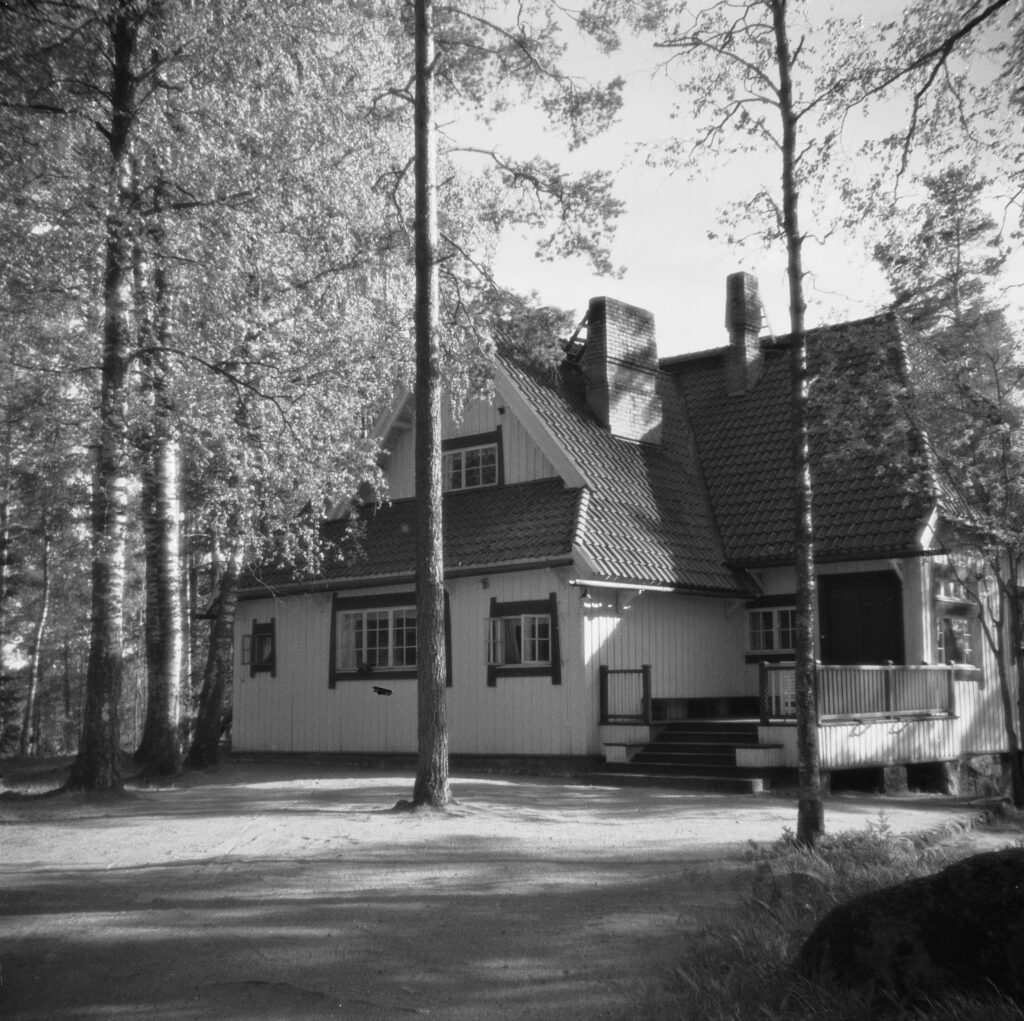
Ainola’s architecture and construction
Aino and Jean dreamt of building their own house from early on. The young family initially lived at various different addresses in Helsinki, but in the late 19th century, Jean Sibelius started feeling the need to distance himself from the boisterous artist life in Helsinki. As Jean later reminisced: “In Helsinki, all singing inside me died.” The family had grown by four daughters and experienced a huge loss when daughter Kirsti died in 1901. The large family longed for a stable and tranquil environment close to nature.
A place for their house was found on a skiing trip Jean and Eero Järnefelt took in 1902, and Jean bought the plot, called Kielomäki, from the Järvenpää manor the following year. Ainola is located on a forested hill, half a kilometre to the east from Lake Tuusulanjärvi. The plot was initially relatively small, but the estate was expanded through land acquisitions over the years. In the end, the approximately four-hectare estate covered the entire forested patch surrounded by fields.
In the late 19th century, Lake Tuusulanjärvi attracted a close community of significant young Finnish artists. The community included, for example, the author Juhani Aho, his artist wife Venny Soldan-Brofeldt, the author J. H. Erkko and the artists Eero Järnefelt and Pekka Halonen. When the Sibeliuses moved to Ainola, they became part of a community of artists already well-known to them. The move turned out to be decisive also to Sibelius as a composer, since the majority of his compositions were created in Ainola.
Architecture and design
Ainola’s main building was designed by architect Lars Sonck. He was best known for his Art Nouveau churches and public buildings, but during his career, he also designed dozens of wooden villas. Ainola differs from Sonck’s previous timber houses, which had been more strongly influenced by vernacular architecture. In Ainola, the only features that refer to traditional building styles include the west- and south-end round log dormer balconies with long corner joints. The different sizes of windows with glazing bars and dark-green casings as well as the cross-gable roof point to Art Nouveau.
When architect Lars Sonck started to design Ainola, Jean Sibelius had two wishes: he wanted a view across Lake Tuusulanjärvi from his study and a green fireplace in the dining room. These wishes came true. The west-side of the house, built on a steep hill, has a high stone foundation and a richly structured façade with large windows over-looking Lake Tuusulanjärvi. The eastern façade, on the other hand, is one-storey lower and dominated by a steep monopitch roof with a red brick chimney.
Ainola’s building work
Ainola’s building work started in autumn 1903 straight after the plot had been purchased, and the project made rapid progress. The foreman for the project was Rikhard Laine, who had been recommended by Juhani Aho to the Sibeliuses. Laine had previously worked as the master builder at Halosenniemi. Approximately five kilometres of timber was needed for the house, and it was brought all the way from Suolahti in Central Finland.
The family moved in in autumn 1904. The timber house was originally not clad on the outside and had a shingle roof with only the downstairs used as living quarters. The downstairs of the house featured the master composer’s study, the dining room, two bedrooms and a kitchen. Behind the kitchen was a room for the family’s long-term employees: Aino Kari, who worked as a housemaid and a nanny, and the cook Helmi Vainikainen. The basement also had a room for Heikki Sormunen, who worked as a caretaker and looked after Ainola’s horse for many years.
Later renovations
Ainola underwent major renovation work in 1911 when the upstairs was converted into living space. The new upstairs space included the parents’ bedroom, Jean’s study and a guest room. The rest of the upstairs was open attic space. The downstairs study was turned into a drawing room, and a new wider doorway was opened between the dining room and the drawing room. The timber walls in the drawing room were wallpapered, and the room was furnished in the bourgeois style of the time. The daughters got both bedrooms at the back of house. At this stage, the house was clad in white board, as Sonck had originally designed.
Ainola has been refurbished at various stages to fit the needs of the inhabitants. In 1915, the kitchen and the servants’ room, which had become cramped, were expanded. In 1935, the downstairs library was re-furnished after the youngest daughter Heidi got married and moved from home. Heidi’s husband, architect Aulis Blomstedt, designed a cosy library in one of the daughters’ rooms. The other room was made into a study and a bedroom for Jean because he no longer liked to climb upstairs.
Ainola’s interior
Ainola was the Sibeliuses’ home for over 60 years, which is why its interior and furniture represent different eras and decades. Some of the furniture has found its way to Ainola as inheritance from both sides of the family; for example, the crystal chandeliers were acquired by Jean’s uncle, a sea captain. The most recent pieces of furniture are from the 1930s and 1950s. In 1939, the Sibeliuses rented flat on Kammiokatu (now Sibeliuksenkatu) in Helsinki for which they bought a lot of furniture. The family gave up the flat after only a couple of years, and all the furniture, including a dining set designed by Werner West, were brought to Ainola.
Modern comforts
Electricity was installed in the house relatively early, already in 1919. A telephone was put in Ainola soon after it was built in 1904, and the phone number was Järvenpää 22. There was no plumbing in Ainola during the lifetime on Jean Sibelius, because pipe noises would have disturbed the composer when he worked. Plumbing was not installed in the house until 1961. In the same decade, electric heating elements were installed in the fireplaces.
Sauna
The tar-coated timber sauna building was completed approximately one year after the main building. In 1925, the sauna was rebuilt after a fire. The simple sauna building boasts well-balanced and unassuming proportions, and its special features included an inventive water supply system. Water was drawn from a near-by well with a shadoof to a spout, which led directly to the sauna washroom. Another spout led from the hot-water tank in the corner of the room to the bathtub in the room next door. The system saved the women of the house many steps both when they were heating the sauna or doing laundry.
The Ainola Foundation preserves the original appearance of the house and the surroundings in cooperation with Senate Properties and the Finnish Heritage Agency.