
Establishing the garden
Having a garden had been especially Aino’s long-term dream, and a kitchen garden was established in Ainola already in the spring of 1905, the following year after the family had moved to the house. The plot was still full of stones after the building work, but despite it, Aino worked on the garden from the beginning on her own: “I was hoeing and shovelling all day long. Sometimes I wept a little and then continued hoeing again.” Over the years, the vegetable gardens were expanded to cover the entire 100-metre-long area in front of the house.
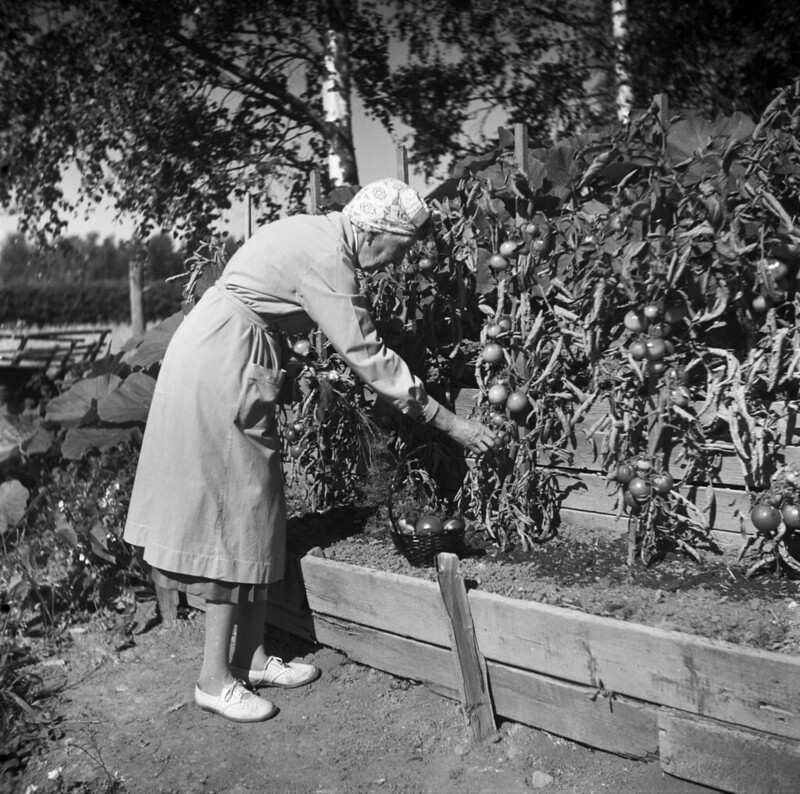
The garden was divided into separate sections: the kitchen gardens for vegetables and root vegetables, the ornamental garden with its splendour of flowers and the apple orchard. In addition to the garden, the Ainola estate includes a wide forested area where particularly Jean spent a lot of time. A wide variety of vegetables from potatoes to asparagus were grown in Ainola, and the south corner of the garden featured a greenhouse that brought a plentiful tomato crop every year. Aino felt passionate about cultivating apples, and she received many awards for her crop. In addition to apples, the Ainola orchard yielded pears, plums and cherries. Berries were also important, and Ainola had numerous currant and gooseberry bushes.
Aino oversaw not only designing the garden and its practical implementation but also attended to harvesting and preserving the crop. In August 1920, Aino wrote to her mother Elisabeth Järnefelt:
“It’s a really busy time here at the moment. There doesn’t seem to be enough hours in a day. Furthermore, the natural force with which the mushroom appeared amazed us completely. Even now, I am in a rush to go to the garden; I go there with trepidation, because it is early in the morning, and I worry that there might have been night frost. It may have caused such damage that I don’t know what I will do. Everything would go to waste. I have only cooked one batch of peas so far. Beans I have not even started picking.”
Significance of the garden
The garden brought almost all the food for the family, and it provided stability particularly in wartime. The kitchen garden ensured self-sufficiency with fruit, berries and vegetables. In addition to being economical, gardening was also aesthetically and socially important. Besides the kitchen garden, Aino also designed an extensive ornamental garden in which flowers were in bloom from early spring to late autumn. Especially the beauty of roses enchanted Aino, and she grew many different rose species in Ainola. For Aino, the garden was her own space where she could relax and forget about her troubles and worries.
In the artist community of Lake Tuusulanjärvi, gardening was an important activity which provided inspiration for art and connected the women of the community. Ahola, Suviranta and Halosenniemi all had big gardens as well. The families traded seeds and cuttings with each other and shared advice on gardening. Aino’s childhood family also valued self-sufficiency and horticulture. Particularly Aino’s mother Elisabeth and brother Arvid looked after their gardens in the spirit of the Tolstoyan movement.
Aino and Jean’s grave
Jean and Aino Sibelius’ grave is located in the warm, southern section of the garden called Rapallo. The Sibeliuses had travelled as a family to a small Italian village of the same name in 1900 and found it delightful. Jean Sibelius was buried in Ainola in autumn 1957 and Aino Sibelius in spring 1969. The deliberately austere bronze monument was designed by the couple’s son-in-law Aulis Blomstedt. Blomstedt designed the grave so that in wet weather the surface of the monument resembles the surface of Lake Tuusulanjärvi, which the composer was very fond of.
The garden today
Ainola’s garden continues to be actively maintained. The Ainola Foundation has been working to restore the ornamental garden since the 1990s, and today it is almost in its original condition. Since 2017, Ainola’s original plants have been cultivated in the sample vegetable patch, and the harvest is used in Café Aulis.
The garden is open to all during the museum’s opening hours. We also organise garden tours in the summer. We wish you a warm welcome to visit Ainola’s garden!